Build notesJONNY//OS
I rebuilt my website.
My website has a power button now. Press it and the page boots into one of fourteen film computers, from HAL to Arrival, each running my work its own way. What’s on it, how it was built, and how the launch film was made.

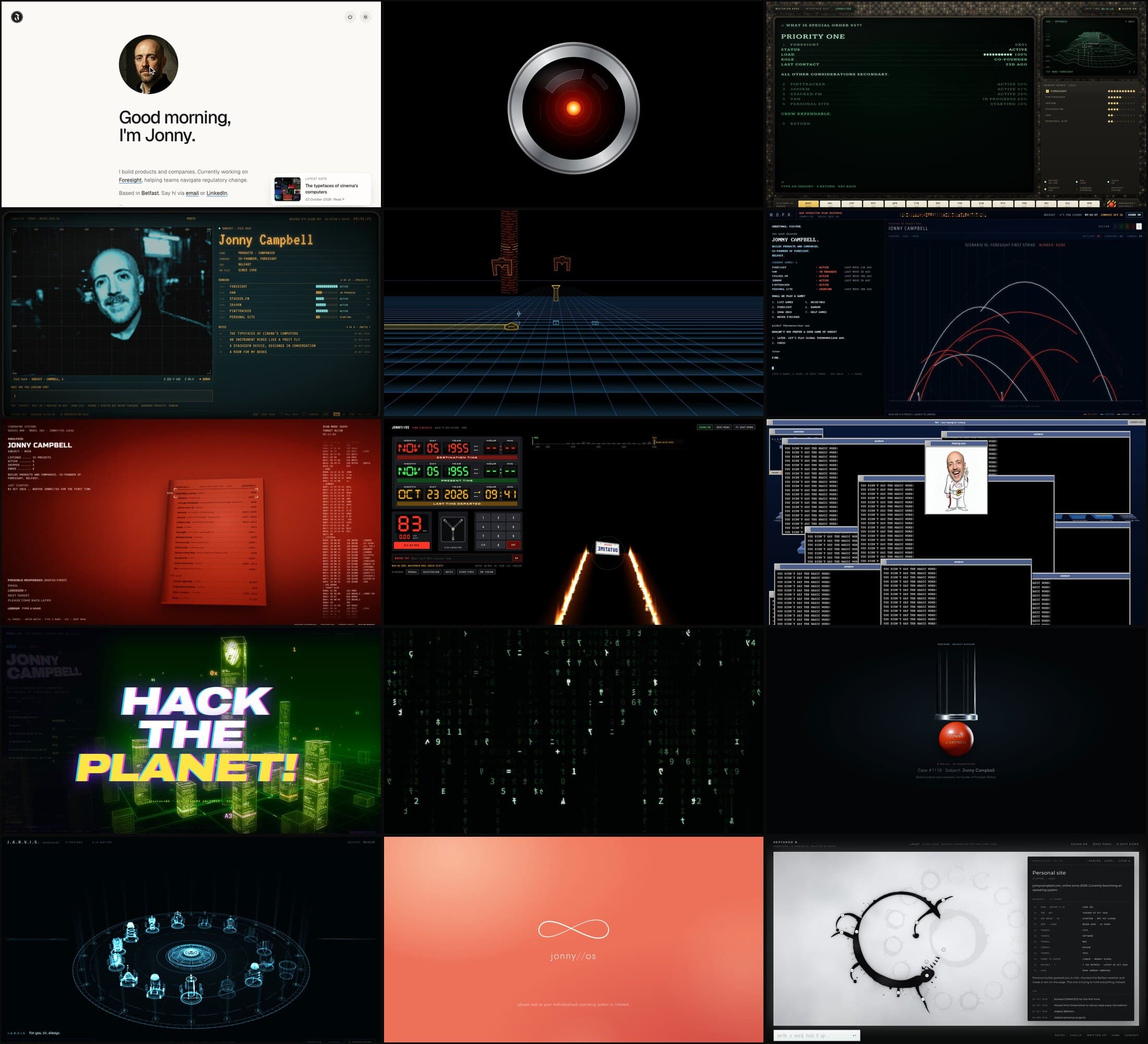
JONNY//OS Fourteen film computers, running my work.
My website used to be a page: who I am, what I've worked on, how to reach me. It's still that, but now it's also closer to a computer. It keeps a log of what I'm up to, publishes notes on what I build, and has a power button. Press it and the page switches off like an old TV and boots into one of fourteen film computers, each one running my work.
Here's a minute of it.
The page
The homepage is still the front door. It says good morning, good afternoon or good evening, depending on the time in Belfast. Click the full stop after my name and it says it another way, sometimes in Irish. Hover over the portrait and it cycles through fourteen styles. Below that, four tabs:
- Work: Foresight now, and carwow and Brewbot before it.
- Personal: the side projects, like the van, StackedFM and Pint Tracker.
- Lately: my posts on X and my outings, set against the sky over Belfast, hour by hour, with a mark for each post.
- Notes: write-ups like this one, on whatever I've been building.
The van has its own page: a build log for the 2021 Citroën Relay I'm converting to travel and work in, a few days at a time.
Every note is labelled AI Assisted or AI Generated. The first note explains why.
It has a power button
Next to the light and dark switch there's a power key, and B on the keyboard does the same. The page switches off the way a CRT did: a flash, a line, a dot. Then a 1990s BIOS counts up my projects, and a boot manager lists fourteen machines, each a film's idea of what a computer would be:
| Year | Machine | Film |
|---|---|---|
| 1968 | HAL 9000 | 2001: A Space Odyssey |
| 1979 | MU/TH/UR 6000 | Alien |
| 1982 | Esper | Blade Runner |
| 1982 | MCP | Tron |
| 1983 | WOPR | WarGames |
| 1984 | T-800 | The Terminator |
| 1985 | Time circuits | Back to the Future |
| 1993 | UNIX system | Jurassic Park |
| 1995 | The Gibson | Hackers |
| 1999 | The Matrix | The Matrix |
| 2002 | Precrime | Minority Report |
| 2008 | J.A.R.V.I.S. | Iron Man |
| 2013 | OS1 | Her |
| 2016 | Heptapod B | Arrival |
Every machine runs the same things, my projects and my notes, its own way. Mother answers questions about them. The Esper's photo is a street in the rain, and enhance finds me in it. The WOPR plots every project as a missile in flight. In Arrival, each project is a logogram, and Louise's laptop translates it.
Shut a machine down and you're back on the homepage, where you left it. Next time, the power key offers the machine you used last. And if you know the Konami code, try it in the boot manager.
What each machine is set in turned into a note of its own: The typefaces of cinema's computers.
How it was built
Like everything else here, it was built in conversation with coding agents. The site moved from DreamHost to Vercel on 2 October, keeping every old link working. JONNY//OS booted for the first time the next day, and the fourteen machines came over the three weeks after.
How the film was made
The film was made the same way, in a long conversation with Claude Code. It's HTML: HyperFrames renders a web page and its animation to video, frame by frame.
Every shot is the real site, recorded from a copy running on my laptop. A script slows the page's clock down 12 to 20 times, takes a screenshot at each step, and rebuilds the frames at 60 a second, so even the fastest animation comes out smooth. When a page scrolls, its motion blur is worked out from how fast it was really moving. Every cut lands on a kick drum, to within half a frame.
The music was made with ElevenLabs Music, then re-cut to fit: the piano intro plays twice, so there's time for the title and the homepage, and the drums run four bars longer, so each machine gets a moment.
Claude can't hear, so it checked the sound by asking audio models to listen and answer questions. They were good at clicks, levels and timing. They were bad at edits: asked whether a stretch of the original track had been edited, one said it was certain, and described a splice that wasn't there. So every join was measured as well as listened to.