Start hereAI & writing
Notes I don’t have time to write.
Every note here is labelled AI Assisted or AI Generated. Why I hand the write-ups to AI, how a note gets made, and why I still think writing matters.

AI Honesty Badge Free badges by Steven Hylands, for saying how you used AI.
Every note on this site has a small badge near the top. Some say AI Assisted. Some say AI Generated. None of them say No AI.
This is the first note, so it's the place to explain why.
What these notes are for
I build a lot of small things: tools, experiments, bits of hardware, new ways of working with AI, and whatever this site turns into next. Most of it never gets written up. I co-founded Foresight, and between that and everything else there's only so much time in the day. Writing up a weekend experiment properly can take longer than the experiment did.
But some of it might be useful to someone: a trick that worked, a tool worth knowing about, a process that saved me a week. Notes are how I want to share that, even when I can't spend the time writing them.
How a note gets made
The work happens in conversation. I build almost everything now in chats with coding agents: Codex, Claude Code, T3 Code, whichever fits the job. By the end, the threads hold most of the story: what I asked for, what came back, what I threw away and why.
Alongside the threads there's a pile of leftovers: screenshots of every version, renders, recordings, scripts, and notes I kept as I went. A few days of building can leave hundreds of files behind.
When I'm done, I hand all of that to an AI with a short brief and ask it to write the note. It reads the threads, goes through the files, pulls out the decisions that mattered and drafts something a person could follow. I ask it to check its claims against the code and the sources, to say when it isn't sure, and to keep it plain.
Then I read it. Some notes go through round after round of my edits until they say what I mean. Some I read, fix a fact or two, and publish. The badge says which.
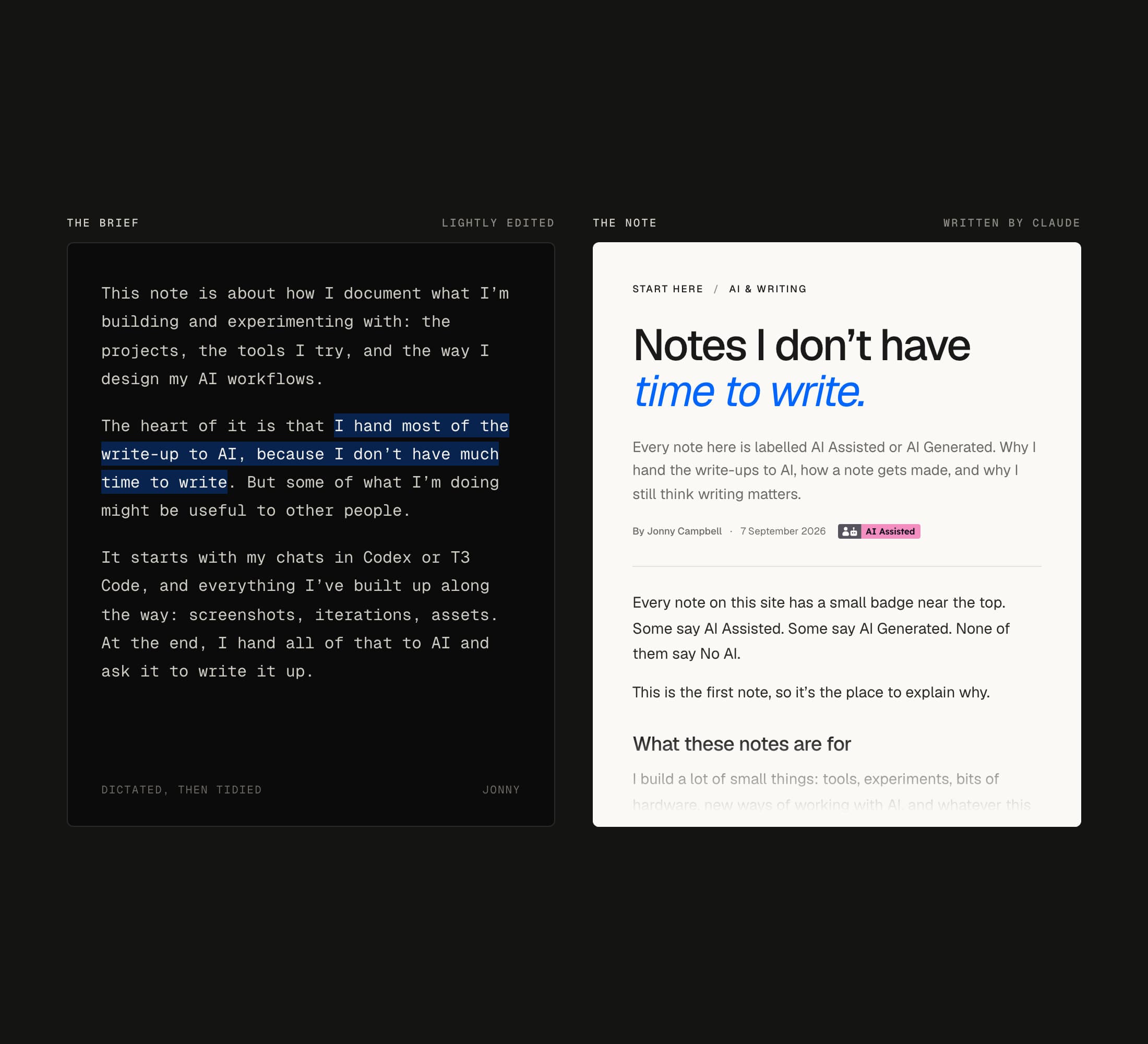
This note started as a brief I dictated. Here's part of it, lightly edited:
The heart of it is that I hand most of the write-up to AI, because I don't have much time to write. But some of what I'm doing might be useful to other people.
Claude tidied that up and wrote the rest.
What the badges mean
The badges are the AI Honesty Badge, made by Steven Hylands, a designer and founder here in Belfast. They're free, and there are three:
- No AI: people made it, start to finish.
- AI Assisted: a person led the work and AI helped, even if AI produced most of it.
- AI Generated: AI made it from a brief, and the person published roughly what came back.
The line between the last two is the useful one. In the badge's own words: "The test is whether you shaped the work or accepted it."
So a note I argued with for an afternoon is AI Assisted. A note where I gave a brief and mostly accepted what came back is AI Generated, even if I care about what it says. This one is AI Assisted: Claude wrote it from my brief, and I shaped it from there.
I label them because you should know what you're reading before you decide how much to trust it. I'd want to know.
Why not write them myself
Because the real choice usually isn't between a note I wrote and a note AI wrote. It's between a note AI wrote and no note at all.
The building is mine, and so is the thinking that went into it: what to try, what's good enough, what to throw away. What I hand over is the write-up, turning a long, messy thread into something someone else can follow. That's real work, and it's the work I'd otherwise skip.
What gets lost
I don't think that trade is free.
Paul Graham made the case in Writes and Write-Nots: "writing is thinking." As AI takes over the writing, he expects "a world of thinks and think-nots."
Dan Shipper, who runs Every, wrote a reply I keep coming back to: "Writing is thinking, but the converse doesn't hold: Writing is not the only way to think." His hope is that "AI will free people from the parts of writing that are otherwise drudgery."
Every is worth watching on this, because they're open about it. Their editorial guidelines say that "Every piece of Every's editorial output has been touched by AI in some way." They also say each piece "has a human author who has shaped the work and stands behind it", and that they still "believe in the value of writing to sharpen thought." Their writers describe their workflows in detail. Katie Parrott starts a piece by asking Claude to "interview me one question at a time to draw out what I think." And Shipper told Platformer the quiet part out loud: "almost every writer is using it. Just, most of them are not saying so."
I land roughly where Shipper does. A lot of my thinking happens in the build, in the back and forth with the agent. That's a kind of writing too, just not the kind anyone else reads.
But some thinking only happens when you sit with a blank page and commit to a sentence, and if I skip that every time, I'll lose it. So I'm drawing a line. Write-ups of things I've built can be AI's job. Anything where the point is what I think, like an argument or a talk, I want to write myself.
How to read them
Read these notes as lab notes: a record of what I built and how, written up by the tools that helped build it, and labelled so you know. The work is real. The words are mostly not mine, and the badge says how much.
If something's wrong or unclear, or you tried it and it didn't work, I'd like to hear about it.
Thanks for reading.
Back to all notesI led the work, and AI helped along the way. Badge by AI Honesty Badge.