Build notesAI & side projects
How Many Days? A register of emergency advice.
I wanted to know how many days each government tells households to prepare for, and whether that’s changed. One Monday afternoon I asked for a website that would find out, and that night it was live. What it does, what it found, and what it took.


How Many Days? What governments tell households to keep at home, with the sources.
On 22 October, the UK launched a website asking households to be ready for 3 days. A month earlier, Ireland had posted a booklet to every home, with no number of days in it at all.
More and more governments tell people to keep water, food and medicines at home. I wanted to know what each one says, how many days, and whether that's changed. On a Monday afternoon I asked for a website that would find out, and that night it was live at daystoprep.com.
This is what it does, what it found, and what it took.
What I asked for
Here's some of my first message:
We want a website that documents what countries are saying about how many days to prepare for, whether they've updated it, and when. Some countries have said 3 days, then increased it.
…
This is going to help people work out how to prepare: how many are in their household, how many days to plan for, how much water and food they'll need. It should have tools, and it should be interactive.
I sent that at 16:05 on Monday 2 November. All of it was in conversation with Claude Opus 5.5, in T3 Code.
What's on it
The front page is a board. Each government's answer stands in a column by its number of days. Press play and it runs from 2013 to now, a month at a time, as the answers arrive and move.
Every figure links to a source you can open, quoted word for word from the government's own page. Press can fill in a date, but press alone never sets a national figure.
Below it:
- A globe you can spin, coloured by each country's figure.
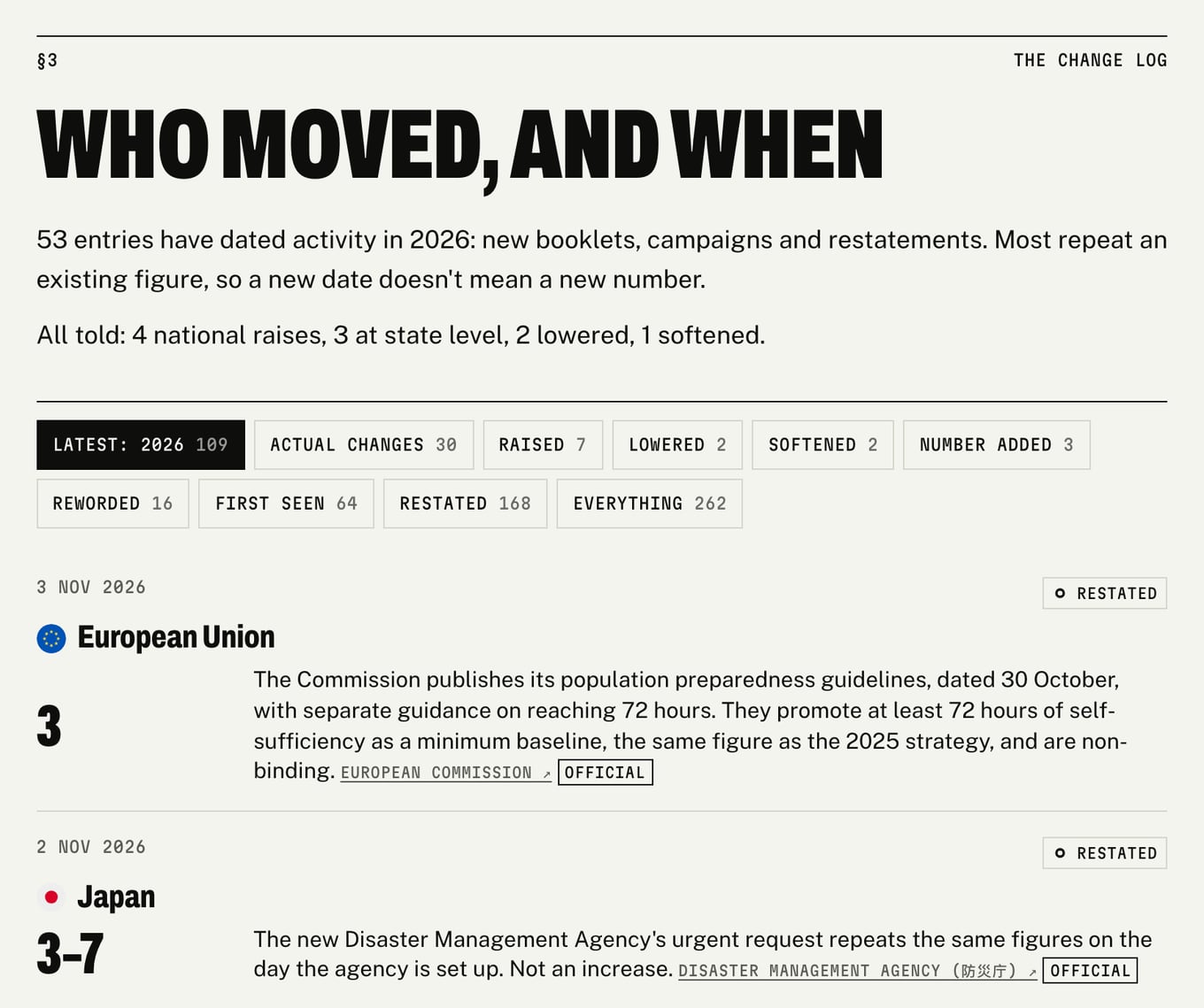
- A change log of every dated change, which you can filter: raised, lowered, number added, restated.
- A page for each entry, with its figure, the quote, every dated step, and the sources, each badged Official or Press.
- A planner. Pick your country and who's at home, from adults to babies, dogs and cats. It works out the water and food, a sensible order to build it up in, and a checklist you can print or share.
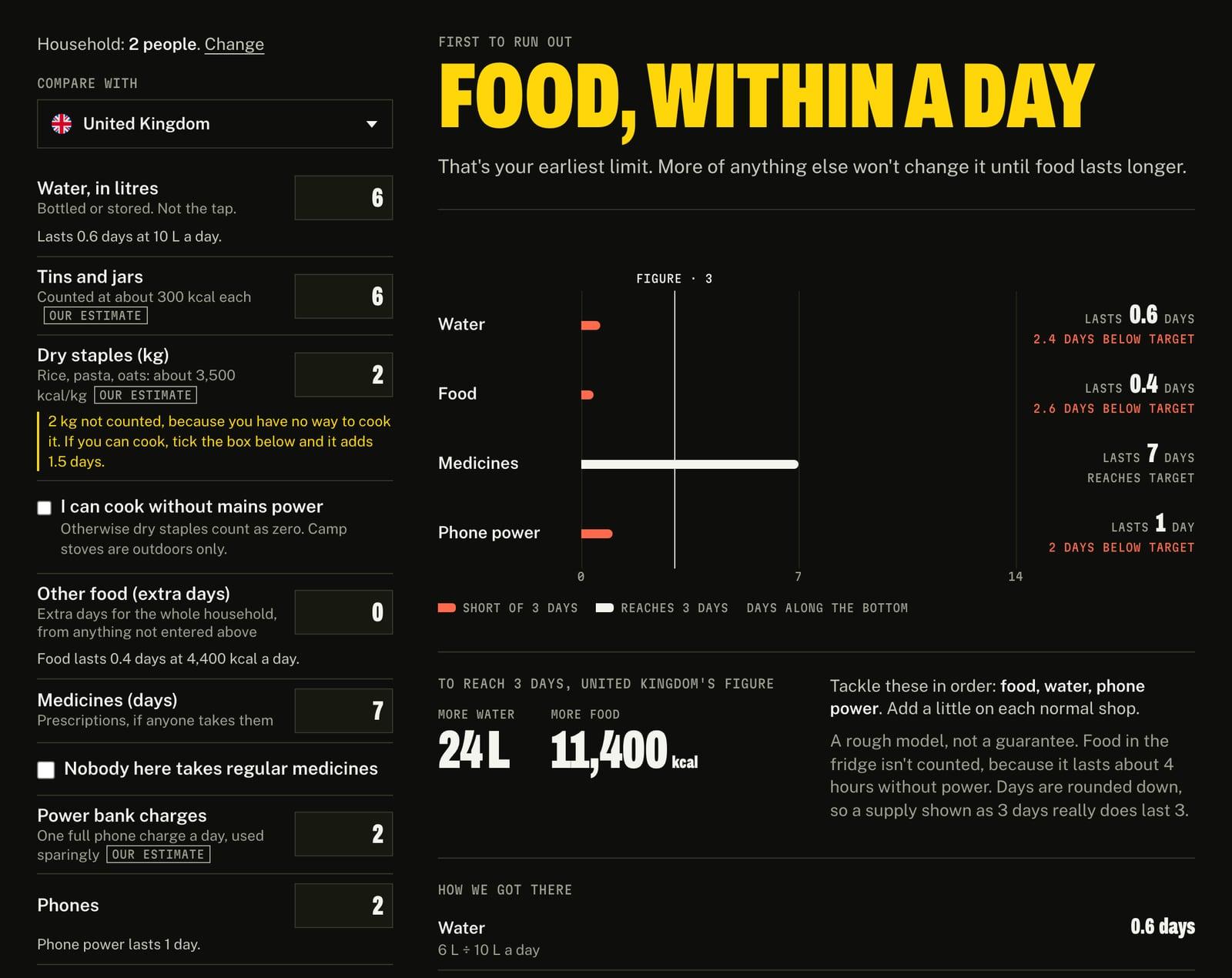
- A stress test. Put in what you've got, and it shows how long each thing lasts, and what runs out first.
The stress test was the part that needed fixing after launch. Late on Monday I tried it, and changing the food didn't seem to change anything. I asked Codex to look into it. It found the sums were right, but the page made them look wrong. Dry food you can't cook counted as nothing, with only a small note to say so. 2.95 days showed as "3 days" while still saying you were short. The chart's scale jumped about as you typed. Codex passed its findings on to the same chat, and the fixes went live that night.
The planner and stress test run in your browser, and what you enter stays there. The whole site works offline once it's loaded, which seemed the least it could do.
What it found
- 41 of the 58 published figures have 3 days as their minimum. It's the most common answer by far.
- A week: Estonia, Norway, Sweden and Taiwan. A few go longer, but most of those are narrower than they sound. Austria's 10 to 14 days and Slovakia's 14 are for a long blackout, Singapore's and the UAE's two weeks are food only, and Albania's 15 days is for being cut off by snow.
- Only 4 national increases can be documented: Japan in 2015, Norway in 2024, and the Netherlands and Taiwan in 2025. Austria and Germany went down.
- 53 entries have dated activity in 2026, and none of it raised a national figure. Belgium, Luxembourg and the UK added a number where they had none.
Most of the activity is the same number, said again. Of 262 dated events, 168 are restatements. My first message assumed countries were raising their numbers. Mostly, they're saying 3 days again.
Getting it live
- 20:18: the code went into a private GitHub repo.
- 21:06: I bought daystoprep.com, through Cloudflare, which hosts the site for free.
- 21:32: it was live. Every change now builds the site, runs the checks and deploys it, and a failed check stops the deploy.
- By 21:56: it had share cards with the address on them, and a flip-counter logo.
Every entry has a link to send a correction. A re-check is set to run once a month, from December. It opens a pull request with anything it finds, but it never merges one, because merging publishes. That stays with me.
The next day
On Tuesday evening, the European Commission published its preparedness guidelines, with at least 72 hours of self-sufficiency in them. I asked for the EU's entry to be updated from the Commission's own pages at 19:40, and it was live at 20:03. It's logged as a restatement, not a raise: the EU's figure was already 3 days, and its guidance isn't binding on the countries that set their own.
The numbers
- 2 hours from my first message to a first version.
- About 5½ hours to its own domain.
- 48 messages from me over two days, and 4 more passed on by Codex.
- 12 commits and about 7,900 lines of code.
- 87 unit tests and 256 browser checks.
- 67 entries, 577 sources, 438 of them official, and 262 dated events.
- About $11 a year for the domain. The hosting is free.
What I learned
The first version is the easy part. It looked finished in two hours. Making it true took the rest: re-reading every source, and saying plainly what couldn't be settled.
A rule beats a reminder. "Avoid misinformation" is a hope. "No figure without a source you can open" can be checked, and the site checks it on every deploy: every figure has a quote and a link, and every change has a source.
The data didn't tell the story I expected. I asked for a site about countries raising their numbers. Mostly, they aren't.
What's real and what isn't
Every picture here is a screenshot or a screen recording of How Many Days?, taken from a copy of the site's own build on my laptop, as it was on 3 November. Its figures were checked on 2 November, and the EU's again on 3 November.
How Many Days? is an independent project, not an official source. Pages change, so check with your local authority before relying on any number on it.
The quote from my first message is edited and shortened. The times come from the chat and the commit history.
Credits
The map comes from Natural Earth, through world-atlas and d3-geo, and the flags are circle-flags. Built in conversation with Claude Opus 5.5 in T3 Code, with Codex on the stress test, on Next.js and Cloudflare.
Thanks for reading.
Back to all notesI led the work, and AI helped along the way. Badge by AI Honesty Badge.